
An inside look at the craftsmanship of Ukiyo-e and Shin-hanga
Japanese woodblock prints are admired around the world for their beauty, subtlety, and astonishing technical precision. Yet many collectors are surprised to learn just how complex and collaborative the printmaking process truly is. Far from the work of a lone artist, traditional Japanese prints were created by a team of specialists,each a master of their craft.
At Paper Tiger Japanese Art, we believe that understanding how a print is made enriches one’s appreciation of both the artwork and the extraordinary skill behind it. This article offers an expert, accessible guide to the traditional woodblock process used in both Ukiyo-e and Shin-hanga printmaking.
1. A Collaborative Art Form
Unlike Western printmaking, which often centres on the individual artist, Japanese woodblock printing relied on four distinct roles:
The Artist (eshi)
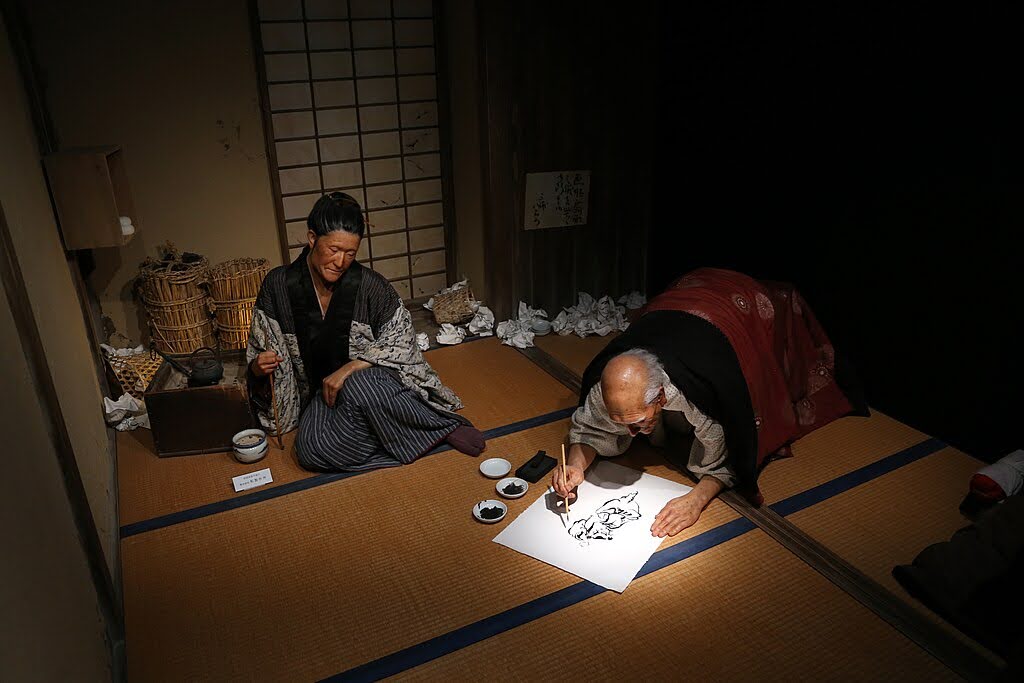
Responsible for the original design, the artist created a detailed drawing on thin paper using brush and ink. This design was the blueprint for the entire process.
The Block Carver (horishi)
The carver transferred the artist’s drawing onto blocks of seasoned cherrywood, carving away everything except the lines and shapes that would receive ink. Each colour required its own block, sometimes a dozen or more.
The Printer (surishi)
The printer applied pigments by hand and pressed sheets of handmade washi paper onto the block using a circular pad called a baren. A delicate balance of pressure, moisture, and pigment created variations in softness, vibrancy, and texture.
The Publisher (hanmoto)
The often-overlooked lynchpin of the process. Publishers financed production, managed distribution, commissioned new designs, and worked closely with artists to anticipate public taste.
This collaboration ensured a level of quality and consistency unmatched in other printing traditions.
2. From Sketch to Finished Design
The artist began with a final line drawing, known as the hanshita-e. This drawing was pasted face-down onto the first block and carved away, destroying the original sketch, one of the reasons surviving preparatory drawings are so rare and valuable.
The first carving produced the keyblock, containing the outlines and defining features of the composition. Once printed, these keyblock impressions served as guides for carving the colour blocks.
3. Carving the Colour Blocks
Each colour in a print required its own woodblock. Carvers worked with extraordinary precision, using knives and chisels to create:
- large flat areas
- delicate shading zones
- fine lines for hair or textile patterns
- special effects such as embossing (karazuri)
The complexity of a print could range from a few blocks to dozens, depending on the design and the ambitions of the publisher.
4. Printing: A Master’s Touch
Printing was both technical and deeply intuitive. The printer had to balance water, pigment, and pressure perfectly for each impression.
Key printing techniques include:
- Bokashi (gradation)
A hallmark of both Ukiyo-e and Shin-hanga. Bokashi creates soft tonal gradation—sunset skies, mist over water, or fading shadows, by wiping or brushing pigments to produce seamless transitions. - Mica (kirazuri)
Shimmering mica powder added to backgrounds for luxurious sparkle, often used in bijin-ga. - Embossing (karazuri)
A technique using pressure alone (no ink) to create raised textures such as kimono patterns or waves. - Burnishing (tsuya-zuri)
Polishing inked surfaces to create a glossy sheen.
Because each impression is printed by hand, no two prints are perfectly identical. Variations in colour strength and pressure are expected, and help experts determine early versus later impressions.
5. Handmade Washi Paper
The paper used for Japanese prints, called washi, is made from the inner fibres of the mulberry tree (kozo). Washi is:
- strong yet lightweight
- slightly textured
- naturally absorbent
- extremely durable across centuries
Its resilience is one reason Ukiyo-e prints have survived in such large numbers despite their age.
For Shin-hanga, higher-quality paper and pigments were often used, creating richer colours and deeper textures.
6. Edition, Impression, and Quality
Understanding how prints are made helps collectors appreciate why early impressions, those printed when the blocks were fresh, are more desirable.
Signs of an early impression:
- crisp, unbroken key lines
- visible woodgrain impressions
- vibrant pigments
- delicate bokashi effects fully intact
Later impressions often show:
- softened lines
- uneven or weaker colours
- reduced detail in carved areas
- diminished special effects
Publishers frequently reissued popular designs, sometimes decades after the artist’s death. This is why correct identification and authentication are essential when collecting.
Final Thoughts
The creation of a Japanese woodblock print is a triumph of craftsmanship and coordination. Every stage, from the artist’s first sketch to the carver’s blade and the printer’s brush, reflects a centuries-old tradition carried out with extraordinary skill.
By understanding how prints were made, collectors can better assess authenticity, appreciate subtle variations, and recognise the artistry behind each impression.
At Paper Tiger Japanese Art, we specialise in authentic Ukiyo-e and Shin-hanga prints and are always happy to help collectors evaluate pieces or build their collections with confidence.
If you have a print you’d like assessed, or are searching for something special, please feel free to get in touch.